


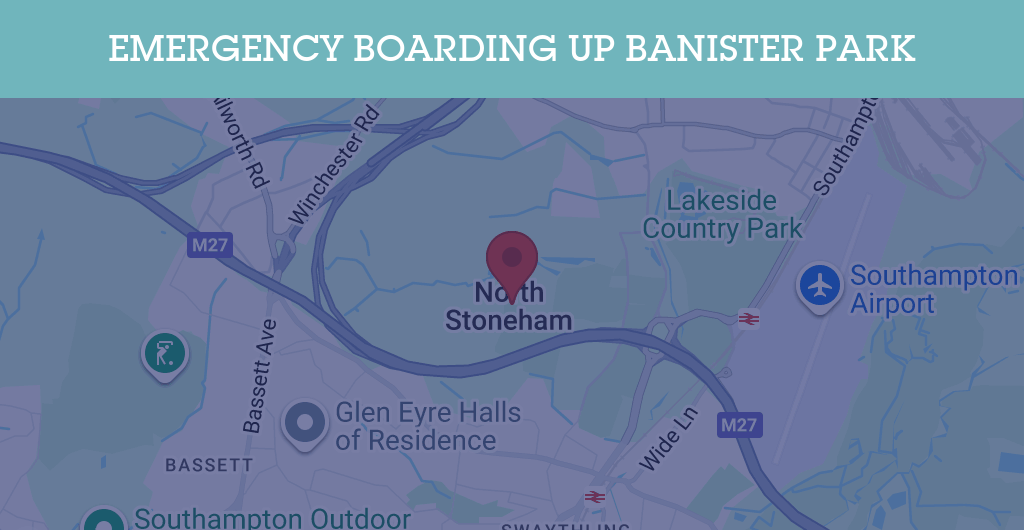
Boarding Up Banister Park (SO15) – Emergency Property Securing in Southampton
If you’re dealing with a smashed window, a forced door, or an exposed shopfront in Banister Park (SO15), the priority is simple: secure the property quickly and safely to reduce further damage and stop opportunistic entry. Boarding up isn’t about making things look pretty—it’s about making the building safe, weather-tight, and difficult to access until repairs can be arranged.
Boarding Up Southampton covers Banister Park and the wider SO15 area, with 24/7 boarding up available for urgent call-outs. We don’t promise a fixed arrival time (traffic and workload vary), but we prioritise emergency boarding up and will give you a realistic ETA on the phone. Our technicians are DBS-checked, we’re fully insured, and we’ve been trading for 10+ years.
Need help now? Call 023 9433 0625 for immediate assistance.
Banister Park (SO15): local support when you need to secure a property fast
Banister Park sits close to the city centre edge, with a steady mix of residential streets, rented flats, and small businesses feeding into the broader SO15 area. That combination matters: when an opening is damaged, there’s often more passing footfall than in quieter suburbs—meaning a broken pane or compromised door can attract attention very quickly.
Whether you need to board up a broken window, make safe after vandalism, or get temporary boarding in place while you speak to your insurer, the goal is the same: secure property without causing unnecessary extra damage. When we attend, we’ll talk you through what’s possible based on the condition of the frame and what you need next (short-term protection overnight vs. a more robust medium-term solution).
Area-specific risks in Banister Park (SO15)
Banister Park’s risks are shaped by the way the area is used—busy routes, a mix of occupancy types, and properties that often include larger or more vulnerable glazed openings.
1) Mixed housing stock and rental turnover
SO15 includes a lot of rented accommodation and HMOs, alongside family homes and blocks of flats. When a window is broken or a door is forced, the urgency can be higher because:
- Tenants may be displaced temporarily
- Landlords need to demonstrate the property was secured promptly
- Empty rooms or temporarily vacant flats can be targeted again
Even one smashed window can quickly become a bigger problem—rain ingress, heat loss, and visibility of valuables from the street.
2) Street-facing glazing and ground-floor vulnerability
Properties near busier roads and main routes often have:
- Ground-floor windows that are easier to reach
- Larger panes (especially in converted buildings)
- Communal entrances that can be compromised by one damaged door panel
That’s where anti-tamper fixings and the right board choice matter. For most external openings we typically favour 18mm exterior-grade plywood for strength and weather resistance; OSB can be suitable for smaller, lower-risk openings depending on exposure and duration.
3) Passing footfall and opportunistic entry
Close to city-centre movement (including areas around Southampton Central Station) a broken opening can draw attention fast—especially out of hours. A property that’s “obviously damaged” can be more likely to see:
- Further vandalism
- People trying handles or pushing at weak points
- Weather damage overnight that turns a repair into a replacement
4) Commercial and mixed-use edges
Where SO15 blends into busier commercial zones, you’ll occasionally see issues like:
- shopfront boarded up after impact damage
- Repeated break attempts at the same frontage
- Wider openings that need proper spanning and safe fixing points
The right approach isn’t always “bigger board, more screws”. It’s about installing boards that can’t be removed from outside, while protecting the remaining frame so your glazier can replace units without unnecessary complications later.
A typical Banister Park call-out (example scenario)
A typical call-out in Banister Park might involve a late-evening report of a smashed window on a ground-floor flat or a converted property. The occupant may have heard the break, found the room exposed, and is worried someone will return.
When we arrive, the first step is a quick safety check:
- Confirm nobody is inside who shouldn’t be (and advise police involvement if there’s any doubt)
- Check for unstable glass, sharp fragments, or a compromised frame
- Assess whether boarding can be fixed non-destructively into reveals or solid structure
We’d then “make safe” by removing loose shards where it’s safe to do so, and installing a board cut to size. Depending on the opening and the frame condition, we’ll use:
- Exterior-grade plywood where stronger, longer-lasting protection is needed
- Anti-tamper fixings so the board can’t be simply backed out from the street side
- A fixing pattern that spreads load to avoid splitting weakened timber
If the frame is too damaged to take fixings safely, we’ll explain options before proceeding—sometimes that means a different fixing strategy, or securing the area in a way that avoids making later repairs harder.
Before we leave, you’ll typically receive:
- Time-stamped photos of the secured opening (useful for insurers/landlords)
- An itemised invoice and brief statement of what was done
- Clear notes on any limitations (e.g., frame movement, water ingress risk)
What to do in an emergency in Banister Park (SO15)
When something’s just happened, it’s hard to think straight. These steps help you stay safe and protect your claim.
-
If there’s danger or intruders, call 999 If you suspect someone is still nearby, or the incident is in progress, don’t approach—call the police first.
-
Make the area safe (without taking risks)
- Keep people away from broken glass
- If it’s safe, close internal doors to limit drafts and keep pets/children out
- Avoid touching cracked panes that are still “hanging on”—they can drop suddenly
- Take quick photos before anything changes From a safe distance, capture:
- The damage (inside and outside if safe)
- Any tool marks, footprints, or impact points
- Wider shots showing the location (helpful for context)
- Call us to secure the opening If you need to board up a broken window, board up a door, or arrange emergency boarding up, call and tell us:
- What’s damaged (window/door/shopfront)
- Whether it’s ground floor and street-facing
- If there’s glass still in the frame or the frame is split
- Whether the property is occupied tonight
Call 023 9433 0625 and we’ll talk you through the next steps and give you a realistic ETA.
- Contact your insurer (and keep your reference numbers)
- Keep any crime reference number (if applicable)
- Ask what evidence they need—photos, invoice, brief description of materials used
We’re not loss adjusters, but we can provide the documentation insurers typically request.
- Don’t “patch it” with unsafe materials Bin bags and tape can flap loose and actually draw attention. Boarding is designed to be rigid, fixed properly, and resistant to removal—especially important if the property will be unattended.
Our local coverage around Banister Park
We cover Banister Park and the surrounding SO15 area, across Southampton. If you’re just outside Banister Park, we can still help—nearby coverage includes:
If you’re unsure whether your address falls under Banister Park or a neighbouring pocket of SO15, call—describe what’s happened and where you are, and we’ll advise.
Banister Park (SO15) boarding up FAQs
How fast can you attend Banister Park if my window has been smashed?
Attendance depends on time of day, traffic, and current emergency workload. We prioritise urgent “make safe” jobs and will give you a realistic ETA when you call. If it’s out of hours, we’ll still aim to attend as soon as possible.
I’m near Southampton Central Station—does that count as SO15 coverage?
Yes—SO15 includes areas close to the station side of the city. If you’re in Banister Park or nearby within SO15, we can help secure the property and provide the documentation you may need for insurance or landlord records.
Can you board up if the frame is split or the door won’t close?
Often, yes—but the method may change. If the frame can’t safely take fixings, we’ll explain the options before proceeding. The aim is always to secure property without making later repairs more expensive.
I’m a landlord—can you provide paperwork for my tenant file and insurer?
Yes. We can supply an itemised invoice and a brief work description, plus time-stamped photos of the boarded opening. That’s usually enough for landlord records and many insurance claims.
Do you board up communal entrances or shared hallway doors in blocks?
Yes, as long as access/authority is clear. For communal areas, we’ll focus on keeping the building secure while maintaining safe access for residents and emergency egress where required.
What if it’s a shopfront and I need it secured overnight?
We can arrange shopfront boarded up solutions designed for larger glazing. If you’re concerned about repeat attempts, tell us—security-focused fixing methods can make a big difference for street-facing premises.
Is temporary boarding weatherproof?
Boarding significantly improves weather protection, but “weatherproof” depends on the damage and the opening. We aim to reduce water ingress and drafts; if the surrounding frame is compromised, we’ll point that out so you can plan the next repair steps.
Need boarding up in Banister Park (SO15)?
If you need emergency boarding up, temporary boarding, or urgent help to make safe after damage in Banister Park (SO15), we’re ready to assist.
Need help now? Call 023 9433 0625. If you can’t speak for long, tell us what’s happened and where you are in SO15 and we’ll call you back with a plan and ETA. You can also email: info@boarding-up-southampton.co.uk.
